
Introduction
The clash between the Denver Broncos and the New York Jets has consistently delivered competitive football, physical defense, and tactical battles on both sides of the ball. Their most recent meeting showcased a defense-dominated contest that highlighted quarterback pressure, strategic play-calling, and critical situational execution.
This article provides a full statistical breakdown of the game, including individual player performances, team comparisons, offensive and defensive efficiency, special teams impact, and key turning points that defined the outcome.
Game Overview
Final Score:
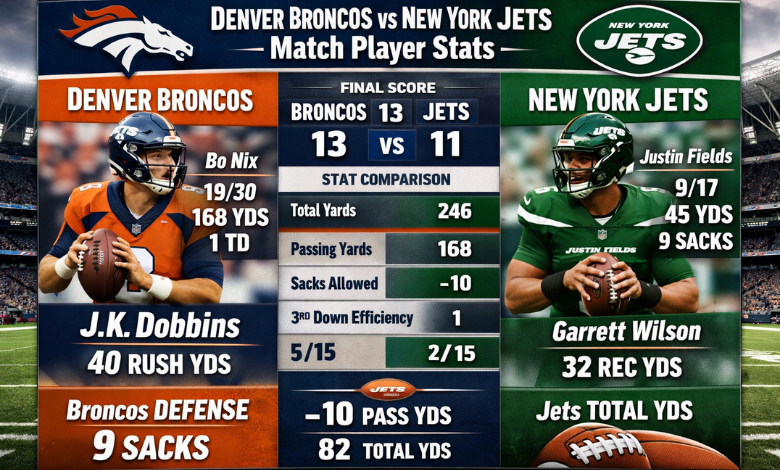
Denver Broncos 13 – New York Jets 11
Location: Tottenham Hotspur Stadium, London
Game Type: Regular Season
Game Style: Defensive struggle with limited offensive production
This matchup was characterized by strong defensive pressure, low scoring drives, and limited passing success from the Jets’ offense. Denver capitalized on key opportunities while maintaining discipline and control.
Team Statistical Comparison
Total Offensive Production
| Category | Broncos | Jets |
|---|---|---|
| Total Yards | 246 | 82 |
| Passing Yards | 168 | -10 (net) |
| Rushing Yards | 78 | 92 |
| Third Down Conversions | 5/15 | 2/15 |
| Turnovers | 0 | 0 |
| Sacks Allowed | 1 | 9 |
The most striking statistic from the game was the Jets finishing with negative net passing yards due to heavy sack yardage losses. Denver’s defensive line dominated the line of scrimmage throughout the game.
Denver Broncos Offensive Player Stats
Quarterback Performance
Bo Nix delivered a composed performance despite facing pressure in certain moments.
Bo Nix Stats:
- 19 completions on 30 attempts
- 168 passing yards
- 1 touchdown
- 0 interceptions
- 1 sack taken
Nix avoided turnovers, which proved critical in a low-scoring contest. His ability to convert mid-range throws helped sustain drives.
Rushing Leaders
Denver relied on balanced ground production to manage the clock.
J.K. Dobbins:
- 40 rushing yards
- Consistent short-yardage gains
While the rushing numbers were not explosive, they were efficient enough to keep drives alive and control tempo.
Receiving Contributions
Denver’s receiving corps focused on short-to-intermediate routes.
Key contributions included:
- Reliable third-down catches
- Red zone efficiency
- Strong route discipline
Although no receiver posted extraordinary yardage, the group executed effectively when needed.
Denver Broncos Defensive Dominance
The Broncos’ defense was the defining factor in the game.
Sack Production
Denver recorded 9 total sacks, which drastically impacted the Jets’ passing efficiency. This pressure forced hurried throws and disrupted timing.
Defensive Line Impact
The defensive front:
- Collapsed the pocket consistently
- Limited passing lanes
- Forced negative plays
This defensive performance ranks among one of the most dominant pass-rushing displays of the season.
New York Jets Offensive Player Stats
Quarterback Struggles
Justin Fields had a difficult outing under constant pressure.
Justin Fields Stats:
- 9 completions on 17 attempts
- 45 passing yards
- 0 touchdowns
- 0 interceptions
- 9 sacks absorbed
Although Fields avoided turnovers, the offensive line struggled to protect him. The sack yardage resulted in negative net passing yards overall.
Jets Rushing Attack
The Jets managed 92 rushing yards as a team, which outpaced Denver’s rushing total. However, the inability to convert on third downs limited scoring opportunities.
The running game showed flashes of effectiveness but lacked consistency in critical moments.
Receiving Performance
The Jets’ receiving corps had limited opportunities due to:
- Defensive pressure
- Short drives
- Disrupted timing
No receiver crossed significant yardage milestones. Most completions were short passes under pressure.
Third Down and Situational Efficiency
One of the biggest statistical gaps came on third down.
- Broncos: 5 conversions out of 15 attempts
- Jets: 2 conversions out of 15 attempts
Denver’s ability to extend drives proved decisive. Meanwhile, the Jets’ inability to convert forced frequent punts.
Special Teams Impact
In a game decided by just two points, special teams execution mattered greatly.
- Denver’s kicker converted necessary field goals
- Punting maintained field position
- Coverage units limited return yardage
Field position played a subtle but critical role in maintaining defensive control.
Key Game Turning Points
Early Defensive Pressure
Denver established dominance early by pressuring the Jets’ quarterback on consecutive drives.
Red Zone Efficiency
Denver capitalized when inside scoring territory, while the Jets stalled.
Fourth Quarter Stand
Late defensive stops sealed the victory for Denver, preventing a potential comeback.
Tactical Breakdown
Why Denver Won
- Superior pass rush
- Zero turnovers
- Better third-down execution
- Balanced offensive play-calling
- Strong situational awareness
Why the Jets Lost
- Offensive line struggles
- Limited quarterback protection
- Inefficient third-down performance
- Minimal red-zone success
Historical Context of Broncos vs Jets Matchups
Historically, matchups between these two franchises have leaned defensive. Their contests often feature:
- Low scoring totals
- Physical defensive play
- Tactical field-position battles
Recent games have followed this pattern, reinforcing the rivalry’s defensive identity.
Individual Performance Highlights
Top Broncos Performers
- Bo Nix (QB): Efficient and turnover-free
- Defensive Line: 9 sacks
- Kicking Unit: Perfect execution
Top Jets Performers
- Justin Fields: Avoided turnovers under heavy pressure
- Running backs: Solid ground yardage
- Defensive unit: Kept game within two points
Statistical Takeaways
- Negative net passing yards for the Jets is extremely rare in modern NFL football.
- Nine sacks in a single game highlights elite defensive execution.
- Low-scoring games often hinge on small situational advantages.
Denver’s discipline and pressure proved just enough to secure the win.
Fantasy Football Implications
From a fantasy perspective:
- Broncos Defense: High-value performance due to sacks
- Bo Nix: Moderate production, safe performance
- Justin Fields: Low fantasy output due to sacks and yardage loss
- Running backs: Modest value due to limited scoring
Defensive players from Denver were the biggest statistical winners.
Overall Game Assessment
This game was not an offensive showcase. Instead, it was a masterclass in defensive disruption and strategic patience.
The Broncos demonstrated:
- Defensive dominance
- Quarterback composure
- Efficient execution
The Jets showed resilience but struggled to overcome consistent pressure.
In close NFL games, protecting the quarterback and converting third downs often determines the outcome. Denver succeeded in both areas.
Conclusion
The Denver Broncos vs New York Jets matchup was a tightly contested defensive battle that showcased how pressure and discipline can define a game. While the Jets showed effort and flashes of potential, Denver’s pass rush and situational efficiency ultimately secured the victory.
In a game decided by only two points, every sack, every third-down conversion, and every field goal mattered. Denver executed slightly better across those critical areas, making the difference in this hard-fought contest.
Frequently Asked Questions (FAQs)
Who had the best performance in the Broncos vs Jets game?
The Denver defense had the most impactful performance, recording nine sacks and limiting the Jets to negative net passing yards.
How did Bo Nix perform in the game?
Bo Nix completed 19 of 30 passes for 168 yards, threw one touchdown, and avoided interceptions, delivering a steady and efficient performance.
Why did the Jets have negative passing yards?
The Jets recorded negative net passing yards due to the significant sack yardage lost from nine quarterback sacks.
What was the key difference between the two teams?
The main difference was defensive pressure and third-down efficiency, both favoring Denver.
Was this a high-scoring game?
No, it was a low-scoring defensive battle that ended 13–11 in favor of the Broncos.